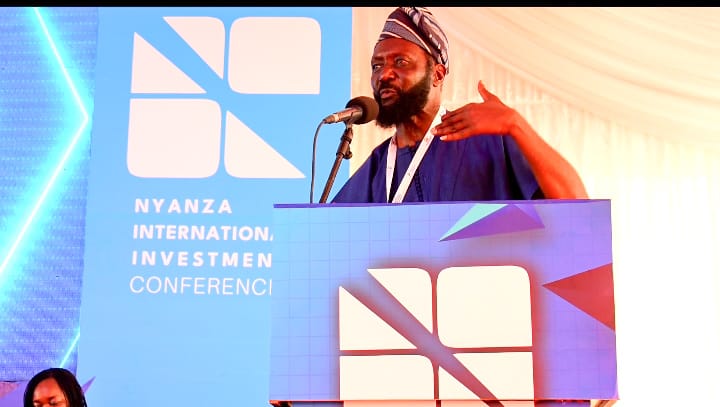
At the Nyanza International Investment Conference 2025, Akech Obat Masira, CEO and Manager of the Mama Grace Onyango Cultural and Social Centre, delivered an impassioned and thought-provoking presentation on the performing arts and the creative economy in Nyanza. His speech highlighted the region’s rich artistic history, the challenges that have led to its decline, and the urgent need to revive, fund, and institutionalize the arts as a pillar of economic transformation.
Masira opened his presentation by reflecting on the vibrant cultural history of Nyanza and the role Kisumu once played as a hub for artistic and cultural excellence. He traced the region’s creative legacy back to the 1960s when artists such as Okot p’Bitek found refuge in Kenya and contributed significantly to the intellectual and artistic landscape. Cultural institutions such as the Ramogi Writers and Drama Society and Kisumu Social Hall played a pivotal role in fostering a dynamic artistic movement that encompassed literature, music, and performance arts. However, this vibrancy gradually faded due to a lack of government support, visionary leadership, and investment in the arts. Masira questioned why the creative economy, once so prominent in Nyanza, had been neglected and why the region’s artistic heritage had not been sustained.
He emphasized the importance of cultural institutions in preserving and nurturing the creative economy. The establishment of the Mama Grace Onyango Cultural and Social Centre was a step toward rekindling the region’s creative spirit. The centre, he explained, was more than just a place for entertainment; it served as a crucial space for intellectual discourse, leadership training, and community empowerment. By drawing comparisons with global artistic movements such as the Harlem Renaissance in New York and Motown Records in Detroit, Masira illustrated how cultural initiatives had the power to elevate communities and create economic opportunities. He urged leaders to recognize the transformative potential of the arts and integrate it into mainstream economic planning.
Despite the immense potential of the creative economy, Masira highlighted the numerous challenges that have stifled its growth in Nyanza. One of the biggest issues was the perception that the arts are merely a form of entertainment rather than a serious economic sector. This misguided notion discouraged young people from pursuing careers in the creative industry. Moreover, government support for the arts had been minimal, with inadequate funding, infrastructure, and professional development programs available for artists. The absence of clear policies to guide the growth of the film, music, theater, and visual arts industries further exacerbated the situation. He was particularly critical of the role of technocrats in the arts sector, arguing that the appointment of individuals with little passion for creative industries had resulted in mismanagement and stagnation. Instead of fostering growth, these officials often focused on justifying expenditures rather than actively developing the industry.
Key Interventions to Revive Nyanza’s Creative Economy
Masira lamented the limited platforms available for young artists to showcase their work. There were few performance spaces, recording studios, publishing houses, and art galleries in the region, which restricted creative expression and career growth. Without such infrastructure, many talented individuals found themselves struggling to gain recognition or earn a sustainable income. He pointed out that while Nyanza had a wealth of artistic talent, the lack of proper support systems forced many artists to relocate to Nairobi or other countries in search of better opportunities.
To address these challenges, Masira proposed several key interventions that would help revive the creative economy in Nyanza. He called for the establishment of a County Arts Endowment Fund, a dedicated pool of resources to support performing arts, film, visual arts, and cultural productions. He suggested an annual allocation of at least KSh 20 million to fund creative projects, provide financial support to young artists, and create employment opportunities within the sector. By investing in the arts, the county government could stimulate economic activity and create a vibrant cultural landscape that attracted both local and international audiences.
He also proposed the creation of a Nyanza Arts Hall of Fame, an initiative designed to recognize and celebrate outstanding contributions to the arts. By honoring accomplished artists, writers, and musicians, the region could cultivate a culture of excellence and inspire younger generations to pursue careers in the creative industry. He emphasized the importance of documenting and preserving the region’s cultural history, as many significant contributions had been forgotten due to a lack of recognition and institutional support.
Masira stressed the need to build more cultural centres with state-of-the-art infrastructure. These centres would serve as hubs for artistic training, festivals, exhibitions, and performances. By investing in such spaces, the government would provide much-needed platforms for artists to develop their craft and reach wider audiences. He applauded Governor Peter Anyang’ Nyong’o’s proposal to establish a one-stop music and film studio at the Mama Grace Onyango Cultural Centre, stating that it would be a game-changer for the creative industry in Kisumu. A fully equipped studio would provide artists with access to professional production facilities, enabling them to compete on a national and international level.
The Role of Technology in Talent Development
Partnerships and collaboration with institutions beyond Kenya were also vital in reviving the region’s creative economy. Masira announced an upcoming International Arts and Culture Exchange Program between Kisumu and New York City, an initiative aimed at exposing local artists to global opportunities. He urged universities, corporate sponsors, embassies, and media houses to support such efforts by investing in cultural programs, providing scholarships for artists, and facilitating international collaborations.
Another major point in Masira’s presentation was the role of technology in talent development. He introduced the Anthro-Biometric Talent Assessment Machine, a cutting-edge tool donated by the World Talent Federation, which could identify children’s artistic abilities 20 to 30 years in advance. He emphasized the importance of leveraging technology to nurture young talent and called on county governments to engage with the centre to facilitate early talent identification and development.
Masira concluded his presentation with a call to action, urging all stakeholders to work together in reviving the creative economy of Nyanza. He stressed that the arts were not just an entertainment avenue but a powerful economic force capable of creating jobs, preserving culture, and transforming lives. He called on governors, policymakers, and investors to prioritize the arts and integrate creative industries into mainstream development plans.
He closed with a vision for the future, likening the potential of Nyanza’s creative economy to the success of Motown in the United States and the Harlem Renaissance in New York. He stated that with the right investments, policies, and leadership, Kisumu could become the cultural capital of East Africa. Drawing inspiration from Lupita Nyong’o’s famous words, “All dreams are valid,” he emphasized that the dream of a thriving creative industry in Nyanza was within reach. He left the audience with a quote from Bob Marley: “One good thing about music, when it hits, you feel no pain. So hit me with music, brutalize me with the music!”
As the conference came to a close, it was evident that Masira’s message had resonated deeply with the audience. His presentation had not only highlighted the challenges facing the creative economy but had also provided a clear roadmap for revitalizing the sector. The call for action was loud and clear—Nyanza’s creative renaissance had to begin now.
Okoth Osewe